Yes — Masai Mara is worth visiting if your goal is a high-probability African safari with exceptional predator viewing, open-plains wildlife, migration drama, strong guiding options, and a landscape that still belongs to one of the world’s great functioning savannah systems.
But it is not worth visiting blindly. The Mara can feel crowded, expensive, and over-commercialized if you choose the wrong season, stay in the wrong location, book too short an itinerary, or treat the safari as a race for river crossings. Its value depends on how you plan it.
The more serious answer is this: Masai Mara is worth visiting because it is not just a tourism destination. It is the Kenyan core of the wider Mara–Serengeti system, where migration, predators, grasslands, rivers, Maasai community lands, conservancies, and tourism economics all meet in one compressed landscape. The Maasai Mara National Reserve Management Plan describes the Reserve as central to the Mara–Serengeti ecosystem and identifies both its global wildlife value and the severe pressures now threatening its long-term viability.
Quick Verdict: Who Is Masai Mara Worth It For?
| Visitor Type | Is Masai Mara Worth It? | Why |
|---|---|---|
| First-time safari visitors | Yes | Strong wildlife density, open visibility, famous species, developed safari logistics |
| Big cat lovers | Yes | One of Africa’s strongest landscapes for lions, cheetahs, hyenas, and possible leopards |
| Migration-focused travellers | Yes, with realistic expectations | Herds and crossings can be extraordinary, but never guaranteed |
| Budget travellers | Yes, carefully | Budget safaris can work, but location, vehicle, and guide quality matter |
| Luxury travellers | Yes | Excellent camps, conservancies, fly-in access, and premium guiding |
| Crowd-averse travellers | Yes, but plan around conservancies or low season | Peak migration zones can be crowded |
| Travellers wanting wilderness solitude only | Maybe | Conservancies may suit better than high-use Reserve zones |
| People expecting guaranteed Big Five ticking | Maybe | Big cats are strong, but rhino is not as easy as in rhino-focused parks |
Why Is Masai Mara Worth Visiting?
Masai Mara is worth visiting because it combines wildlife density, landscape openness, predator visibility, migration ecology, Maasai cultural history, and global conservation significance in a way few safari destinations can match.
Its value comes from several overlapping attributes:
- The Great Migration reaches the Mara as part of the wider Mara–Serengeti system.
- Open savannah makes wildlife easier to see than in thicker habitats.
- Big cats are a major strength, especially lions and cheetahs.
- The Mara River adds ecological drama, dry-season water, hippos, crocodiles, and river-crossing sites.
- Conservancies around the Reserve provide lower-density safari options and community-linked conservation.
- Year-round resident wildlife means the Mara is not only worth visiting during migration season.
- Tourism infrastructure is well developed, making the Mara easier for first-time safari visitors than many wilder, less accessible landscapes.
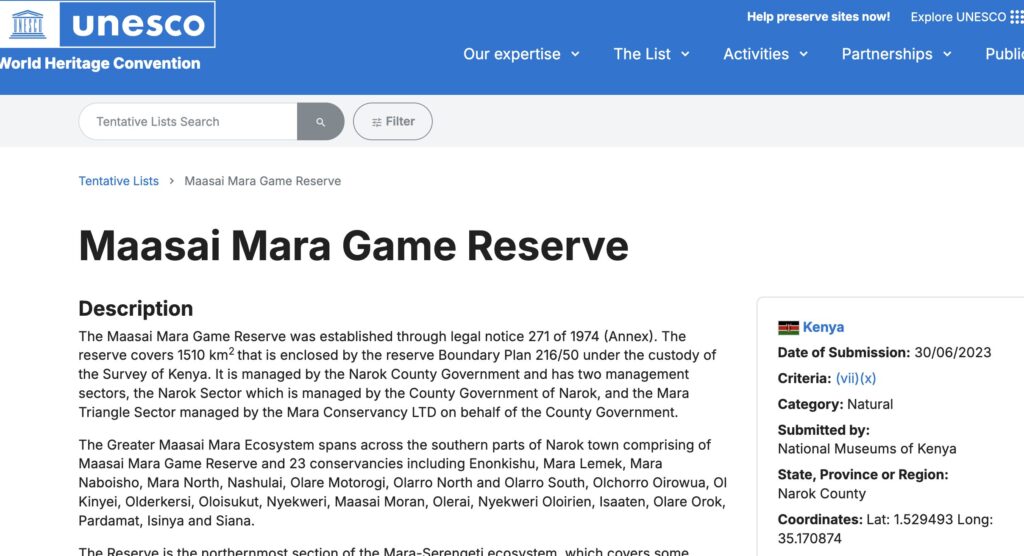
UNESCO’s Serengeti World Heritage description places the Maasai Mara National Reserve within the larger Serengeti ecosystem and notes that the system is defined by the annual migration, while also warning that Serengeti alone does not protect the entire ecosystem. See Masai Mara’s tentative UNESCO listing here.
Is Masai Mara Overrated?
Masai Mara is not overrated ecologically, but it can be overhyped commercially.
The Mara is genuinely exceptional because it sits inside one of the last great terrestrial migration systems on Earth. However, some safari marketing reduces it to a simple promise: come during migration season and see a dramatic river crossing. That is where disappointment begins.
The Mara is not a wildlife theatre. It is a living ecosystem. River crossings are uncertain. Predator sightings depend on time, patience, and guiding. Crowds can build around famous sightings. Roads can be difficult in wet weather. Safari quality varies sharply by camp location and operator quality.
Masai Mara is not overrated as a wildlife ecosystem, but it can feel overrated if visitors expect guaranteed river crossings, empty wilderness, cheap luxury, or close-up predator sightings on demand.
Is Masai Mara Worth Visiting During the Great Migration?
Yes, Masai Mara is worth visiting during the Great Migration, but migration season is also when expectations, prices, and crowding are highest.
The migration is worth it if you want:
- large herds of wildebeest and zebra;
- possible Mara River crossings;
- predator-prey drama;
- classic documentary-style safari scenes;
- the most famous version of the Mara experience.
But migration season also brings:
- higher accommodation prices;
- limited availability;
- more vehicles around crossings;
- crowded predator sightings;
- pressure on guides and wildlife;
- disappointment if crossings do not happen during your stay.
The MMNR Management Plan identifies severe overcrowding and vehicle congestion, especially at Mara River crossings and predator sightings, as a major threat to both the visitor experience and the Reserve’s ecological values.
Best advice:
Go during migration season for the chance of spectacle, not for a guaranteed performance.
Is Masai Mara Worth It Without the Migration?
Yes. Masai Mara is still worth visiting outside migration season because it has strong resident wildlife, excellent predator viewing, birdlife, elephants, giraffes, buffalo, plains game, hyenas, hippos, crocodiles, and dramatic open landscapes.
Outside migration season can be better for visitors who want:
- fewer vehicles;
- better value;
- greener scenery;
- calmer game drives;
- strong big cat viewing;
- more flexible accommodation availability;
- less pressure around the Mara River.
The mistake is thinking the Mara only matters when wildebeest are crossing rivers. The migration is the most famous event, but the ecosystem’s year-round value comes from resident wildlife, predator-prey dynamics, river systems, grassland productivity, and the wider Greater Mara landscape.
Masai Mara is worth visiting even without the migration because it has excellent resident wildlife, strong predator populations, open plains, elephants, giraffes, buffalo, hippos, crocodiles, and rewarding year-round game drives.
Is Masai Mara Worth the Money?
Masai Mara is worth the money when the safari is well designed. It is not worth the money when the itinerary is rushed, the camp location is poor, the vehicle is weak, the guide is inexperienced, or the package hides important fees.
You are not only paying for accommodation. You are paying for access to a high-value wildlife landscape, skilled guiding, park or conservancy fees, vehicles, fuel, logistics, staff, conservation costs, and time in the field.
| Cost Factor | Why It Affects Value |
|---|---|
| Camp location | Determines how much time you spend with wildlife versus in transit |
| Guide quality | Determines how well you understand behaviour, tracks, movement, and ethics |
| Vehicle type | Affects comfort, visibility, safety, and road access |
| Season | Migration months cost more and book earlier |
| Park/conservancy fees | Add real cost but support management and conservation |
| Trip length | Too few days can make the safari feel poor value |
| Private vs group safari | Private costs more but improves flexibility and photography |
Masai Mara is worth the money if you choose a good location, enough days, a reliable vehicle, and a strong guide. It becomes poor value when visitors choose the cheapest option without checking logistics.
Is a Budget Masai Mara Safari Worth It?
A budget Masai Mara safari can be worth it, but only if the operator is transparent and the itinerary still gives you real game-drive time inside the right areas.
A budget safari is acceptable when:
- the camp location is clearly stated;
- park fees and exclusions are clear;
- the vehicle is safe and suitable;
- the number of passengers is reasonable;
- game-drive time is realistic;
- the operator has reliable reviews;
- the guide follows wildlife rules.
A budget safari is risky when:
- the camp is far from the Reserve;
- fees are hidden;
- the itinerary promises too much in too little time;
- the vehicle is overcrowded;
- the operator will not name the accommodation;
- the route adds long transfers every day;
- the price is unrealistically low.
Expert rule:
Save money on luxury, not on guide quality, vehicle safety, location, or enough time in the Mara.
Is a Luxury Masai Mara Safari Worth It?
A luxury Masai Mara safari is worth it when the higher cost buys better location, privacy, guiding, conservation quality, comfort, and lower vehicle density.
Luxury is not just about a beautiful tent. The real value is often in:
- better wildlife access;
- experienced guides;
- private or low-density vehicles;
- conservancy locations;
- high-quality meals and service;
- fewer logistical problems;
- fly-in convenience;
- stronger interpretation of the ecosystem.
But luxury does not automatically mean better conservation. A high-end camp is only truly worth celebrating if it respects habitat limits, supports communities, manages waste properly, and avoids adding pressure to already crowded zones.
Is a Private Masai Mara Safari Worth It?
For many visitors, yes. A private safari vehicle is one of the most valuable upgrades in the Mara.
It is especially worth it for:
- photographers;
- families;
- honeymooners;
- older travellers;
- first-time visitors who want flexibility;
- birders;
- big cat enthusiasts;
- anyone who dislikes rigid group schedules.
| Private Safari Advantage | Why It Matters |
|---|---|
| Flexible timing | Stay longer at meaningful sightings |
| Better photography | Control vehicle positioning more easily |
| Family comfort | Adjust pace for children |
| Wildlife ethics | Avoid pressure from mixed passenger expectations |
| Better learning | Ask more questions and follow interests |
| Less frustration | No need to negotiate every stop with strangers |
A group safari can work well for budget travellers, but a private safari usually produces a deeper and calmer experience.
Is Flying to Masai Mara Worth It?
Flying to Masai Mara is worth it if you have limited time, want comfort, or are booking a short high-value safari. Driving is better if you want to reduce cost or keep the same vehicle and guide throughout.
| Option | Worth It When | Main Tradeoff |
|---|---|---|
| Fly-in safari | Short trip, luxury camp, limited time, comfort priority | Higher cost, luggage limits |
| Road safari | Budget control, private vehicle, flexible route | Long travel day |
| Drive one way, fly one way | Balanced comfort and cost | Requires careful logistics |
Flying to Masai Mara is worth it for short trips and comfort-focused travellers because it saves time. Driving is usually better for budget travellers and those who want one private vehicle throughout the safari.
Is Masai Mara Too Crowded?
Masai Mara can be crowded, especially during migration season, near river crossings, around big cat sightings, and in high-use zones of the Reserve.
This does not mean the whole Mara is always crowded. Crowding depends on:
- season;
- exact location;
- time of day;
- guide strategy;
- whether you stay in the Reserve or a conservancy;
- whether you chase every radio call;
- how close you are to migration hotspots.
The MMNR Management Plan estimates that high-season visitor densities in parts of the Central Mara were well above the Reserve’s proposed optimal carrying capacity of about 1–1.2 visitors per km², with some estimates for Central Mara reaching 2–3 visitors per km² during high-use periods.
Masai Mara is not too crowded everywhere, but peak migration areas and predator sightings can become crowded. Visitors can reduce this by choosing conservancies, avoiding peak periods, staying longer, and using patient guides.
How Can You Avoid Crowds in Masai Mara?
You avoid crowds in Masai Mara by planning against predictable pressure.
Best strategies
- Stay in a private conservancy for lower vehicle density.
- Travel in January–March, June, November, or early December instead of peak migration months.
- Choose a camp based on location, not only price.
- Start early before general vehicle movement builds.
- Avoid guides who chase every radio call.
- Spend more days so you do not need to rush.
- Use a private vehicle if budget allows.
- Treat river crossings as a possibility, not the whole trip.
The surrounding conservancies matter because the Greater Maasai Mara Ecosystem plan identifies the wider ecosystem as a coordinated landscape made up of the Reserve, conservancies, and non-protected areas, rather than the Reserve alone.
How Many Days Make Masai Mara Worth It?
For most visitors, 3 days is the minimum and 4 days is the better value point.
| Time in Mara | Worth It? | Honest Assessment |
|---|---|---|
| 1 day / day trip | Usually no | Too far and too rushed from Nairobi |
| 2 days / 1 night | Sometimes | Works only for tight schedules, especially if flying |
| 3 days / 2 nights | Yes | Classic minimum, with one full safari day |
| 4 days / 3 nights | Strong yes | Better pacing and stronger wildlife chances |
| 5+ days | Excellent | Best for migration, photography, conservancy + Reserve combinations |
Masai Mara becomes properly worth it from 3 days / 2 nights, but 4 days / 3 nights gives better value because you get more game-drive time and less pressure from travel logistics.
Is Two Days in Masai Mara Worth It?
Two days can be worth it only if your expectations are modest or you fly in. By road, a 2-day safari can feel too rushed because travel consumes much of the itinerary.
Choose 2 days only if:
- you have no extra time;
- you accept limited game-drive hours;
- you are flying or using efficient logistics;
- the camp is well located;
- the goal is a brief taste, not a deep safari.
For a first safari, 3 or 4 days is much better.
Is Masai Mara Worth It for Big Cats?
Yes. Masai Mara is one of the best safari landscapes in Africa for big cats, especially lions and cheetahs.
Its big cat value comes from:
- open plains;
- strong prey base;
- visible hunting grounds;
- resident lion prides;
- cheetah-friendly grasslands;
- hyena clans;
- riverine and thicket areas for leopards;
- conservancies with lower vehicle density.
The Reserve management plan identifies large carnivores as ecologically and economically essential, while also noting concerns about carnivore pressures, prey decline, habitat change, and human-wildlife conflict.
Masai Mara is worth it for big cats because lions and cheetahs are strong attractions, hyenas are common, and leopards are possible in riverine and wooded areas.
Is Masai Mara Worth It for the Big Five?
Masai Mara has the Big Five, but it is not the best destination if your only goal is guaranteed Big Five ticking.
| Big Five Species | Mara Expectation |
|---|---|
| Lion | Strong chance |
| Buffalo | Good chance |
| Elephant | Good chance |
| Leopard | Possible, not guaranteed |
| Black rhino | Present but difficult and localized |
The Mara is strongest for big cats, open-plains wildlife, migration, and predator-prey ecology. For easier rhino viewing, visitors often combine it with Lake Nakuru, Ol Pejeta, or Nairobi National Park depending on route and goals.
Masai Mara is worth it for the Big Five, but it is stronger for lions, elephants, buffalo, and predators than for easy rhino sightings.
Masai Mara vs Serengeti: Which Is More Worth It?
Masai Mara and Serengeti are not rivals so much as two parts of one larger ecological system.
| Factor | Masai Mara | Serengeti |
|---|---|---|
| Country | Kenya | Tanzania |
| Scale | Smaller and more concentrated | Vast and more expansive |
| Best for | Shorter safaris, big cats, migration crossings | Longer migration circuit, calving, scale |
| Visitor logistics | Easier for Kenya itineraries | Better for Tanzania circuits |
| Crowding | Can be intense in peak areas | Varies by region and season |
| First safari value | Very strong | Very strong, but often needs more days |
Verdict:
Choose Masai Mara if you want a compact, high-impact Kenya safari. Choose Serengeti if you want a longer, more expansive Tanzania migration itinerary. Choose both if you have enough time and budget.
Masai Mara vs Amboseli: Which Is More Worth It?
Choose Masai Mara for big cats, migration, open-plains predator viewing, and classic safari density. Choose Amboseli for elephants, Kilimanjaro views, wetlands, and a shorter drive from Nairobi.
| Safari Goal | Better Choice |
|---|---|
| Big cats | Masai Mara |
| Elephants | Amboseli |
| Great Migration | Masai Mara |
| Kilimanjaro scenery | Amboseli |
| First safari with maximum wildlife variety | Masai Mara |
| Shorter Nairobi-based safari | Amboseli |
For first-time visitors choosing only one major Kenya park, Masai Mara usually offers the broader safari experience. Amboseli is an excellent complement.
Masai Mara vs Tsavo: Which Is More Worth Visiting?
Choose Masai Mara for concentrated wildlife, big cats, migration, and easier sightings. Choose Tsavo for scale, elephants, red-earth landscapes, dryland ecology, and a more expansive wilderness feeling.
| Factor | Masai Mara | Tsavo |
|---|---|---|
| Signature experience | Migration and predators | Elephants and dryland wilderness |
| Wildlife visibility | High | More dispersed |
| Landscape | Open savannah and river systems | Semi-arid plains, lava, springs, rocky country |
| Best for first-timers | Usually Mara | Good for repeat or longer Kenya safaris |
| Crowd issue | Higher in peak zones | Often more dispersed |
Verdict:
Masai Mara is generally more rewarding for a first safari. Tsavo is more rewarding for travellers who value space, elephants, dryland ecology, and lower-density exploration.
Masai Mara vs Lake Nakuru: Which Is More Worth It?
Masai Mara is worth it for big cats, open savannah, migration, and a full safari experience. Lake Nakuru is worth it for rhinos, birds, lake scenery, and easier access from Nairobi or Naivasha.
| Safari Goal | Better Choice |
|---|---|
| Big cats and migration | Masai Mara |
| Rhinos | Lake Nakuru |
| Birding and lake scenery | Lake Nakuru |
| Classic multi-day safari | Masai Mara |
| Shorter add-on park | Lake Nakuru |
A strong Kenya itinerary can combine both: Mara for predators and plains, Nakuru for rhinos and lake ecology.
Is Masai Mara Worth It for Responsible Tourism?
Yes, but only if visitors and operators behave responsibly.
The Mara’s conservation value is now inseparable from tourism pressure. Revenue supports conservation and community livelihoods, but uncontrolled tourism can degrade the very wildlife experience people come to see.
Responsible tourism means:
- choosing ethical operators;
- respecting wildlife distance;
- not pressuring guides to drive off-road;
- supporting conservancies where appropriate;
- staying longer rather than rushing;
- using camps with strong environmental practices;
- respecting Maasai culture;
- avoiding crowding at predator sightings;
- treating crossings as sensitive wildlife events.
The Greater Maasai Mara Ecosystem Management Plan is built around integrated management, community benefits, ecosystem services, evidence-based planning, and coordination between the Reserve, conservancies, and non-protected areas.
The Deeper Perspective: Why Masai Mara’s Value Goes Beyond Reviews
The question “Is Masai Mara worth visiting?” is usually asked as a consumer decision. Is it worth the money? Is it better than Serengeti? Is it too crowded? Will I see the migration?
Those are valid questions. But they are not enough.
At a higher level, the Mara is worth visiting because it compresses the central dilemma of modern African conservation into one visible landscape. It is globally famous, economically powerful, ecologically fragile, culturally Maasai, scientifically significant, and increasingly pressured by the very tourism economy that depends on its survival.
The Mara’s value is not just that you may see lions, cheetahs, elephants, wildebeest, or river crossings. Its value is that you can still witness an ecosystem where grass, rain, rivers,